
The starting point
Where it started.
MailMend is an email deliverability company. Its sales team closes new clients on calls, and each new client accepts a service agreement and pays a fee before work starts.
Until this build, those were separate steps. The rep closed the deal on the call. The contract went out afterwards. Payment waited until the contract came back.
When MailMend reviewed the deals it had lost, the contract stage kept coming up. People who had said yes on the call were dropping out somewhere between the agreement arriving and the payment being made.
What was getting in the way
- The contract was a separate step after the call, with its own back and forth
- MailMend’s own review of lost deals kept pointing at the contract stage
- Agreement and payment were two jobs, so a yes could sit unsigned and unpaid
The approach
How we thought about it.
MailMend’s idea was simple: make signing up feel like buying software. Nobody negotiates a software subscription over email. They read the terms, tick a box and pay. The brief was to give MailMend’s clients that same experience, with a proper record behind it.
The checkout was built into the sales dashboard the team already works in, so a rep never leaves the place where the call was logged. That choice shaped everything after it. From the moment a checkout is created, it knows which client, which rep and which deal it belongs to.
It also meant the agreement had to be handled with care. A tick box is quick, but the business still needs to prove what was agreed. So the build records each acceptance and freezes the wording the client saw.
Inside the build
What we built, and why.
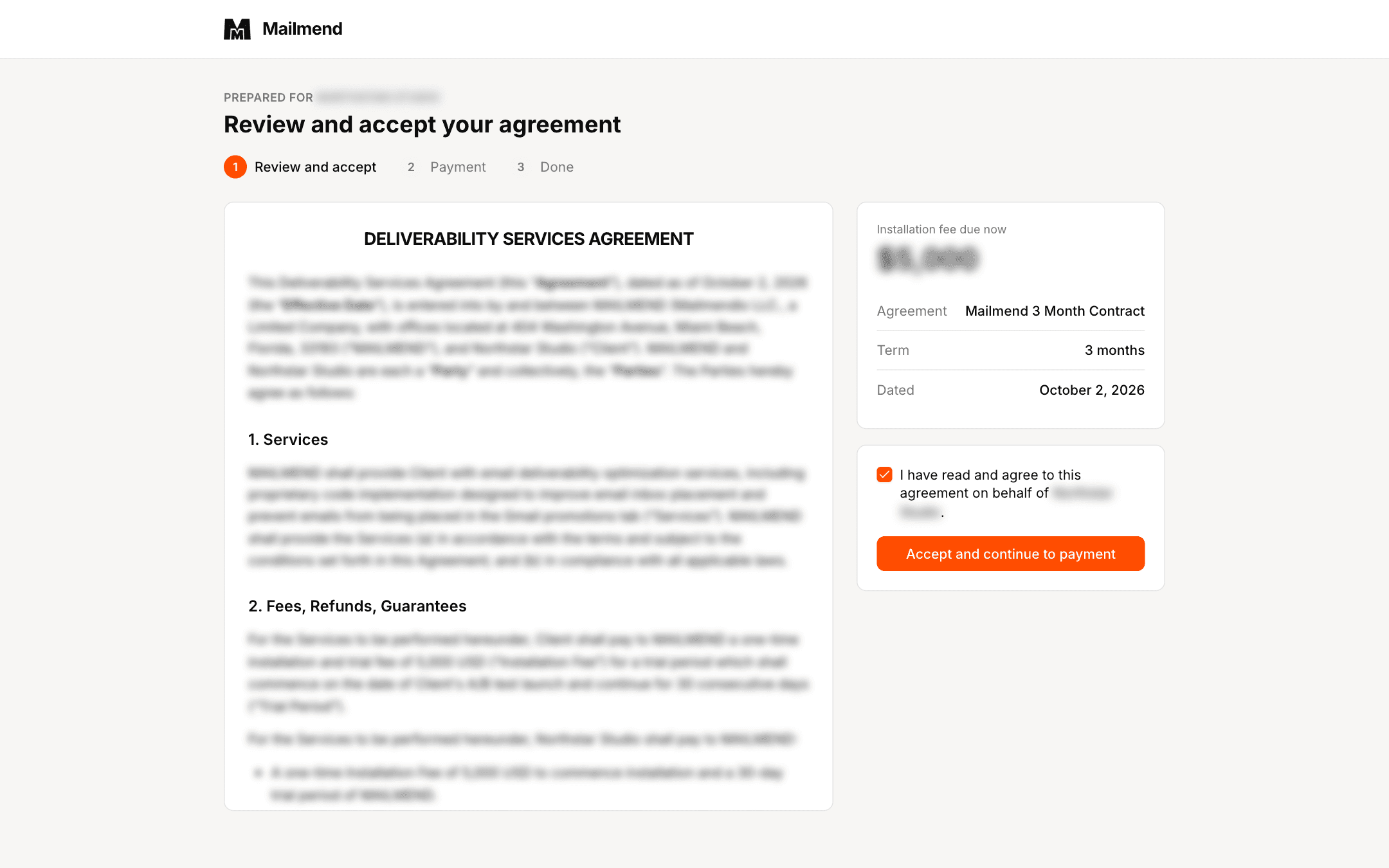
The agreement is frozen when the link is made
Each checkout keeps its own copy of the agreement with the client’s details filled in. If the template is edited later, what that client saw and accepted does not change.
MailMend controls the wording
Admins write and edit agreement templates in a rich-text editor, with version history. They can add or archive a template without a developer.
Payment follows acceptance
The payment link is created only once the client has accepted. Each payment is tied to its checkout, so it arrives already matched to the client and the rep.
Nothing sits unnoticed
Links expire, an accepted but unpaid agreement can be voided, and a health check flags any agreement accepted and still unpaid after three days.
How it works
From start to finish.
From the rep’s side it takes about a minute. From the client’s side it is one page.
- Deal agreedThe rep opens the call record and starts a checkout for that client.
- Checkout createdThe rep picks the agreement, sets what is due at signing and checks a live preview.
- Client opens the linkA private link shows the client their agreement. The dashboard records that it has been viewed.
- Tick to acceptThe client ticks to accept. The time, IP address and browser are saved.
- PayThe payment step opens only after acceptance, through MailMend’s payment provider.
- Matched to the dealThe payment arrives in the dashboard against the right client and the rep who closed it.
Decisions that shaped it
The choices behind it.
A tick box, like buying software
MailMend chose the motion people already use to buy software. Each acceptance is recorded with its time, IP address and browser, and the client can save a copy as a PDF.
Inside the tool the team already uses
Reps create a checkout from the call record, so there is no second system to log in to and nothing to copy across.
Permission by role
Creating checkouts is a permission admins grant to reps. Editing the agreements stays with admins.
Where it stands
Where it stands.
The checkout was delivered in October 2026. It is too early to report results, so this page describes what was built and why, not what it achieved.
A checkout like this removes the friction of signing: the separate document, the wait and the chasing. It does not change the terms themselves. If a buyer objects to what an agreement says, that is a conversation about the offer, and no page settles it.
The agreement wording is MailMend’s own. We built the system that presents and records it, and we do not give legal advice.